

Throughout my research into the history of women’s baseball and softball, I have repeatedly encountered the assertion that the All-American Girls Professional Baseball League (AAGPBL) remained racially segregated throughout its existence, with no Black ballplayers ever signed during the league’s 1943-1954 run. That interpretation has become widely accepted within the scholarly world. However, a recently examined newspaper clipping suggests the possibility of a more complicated story.
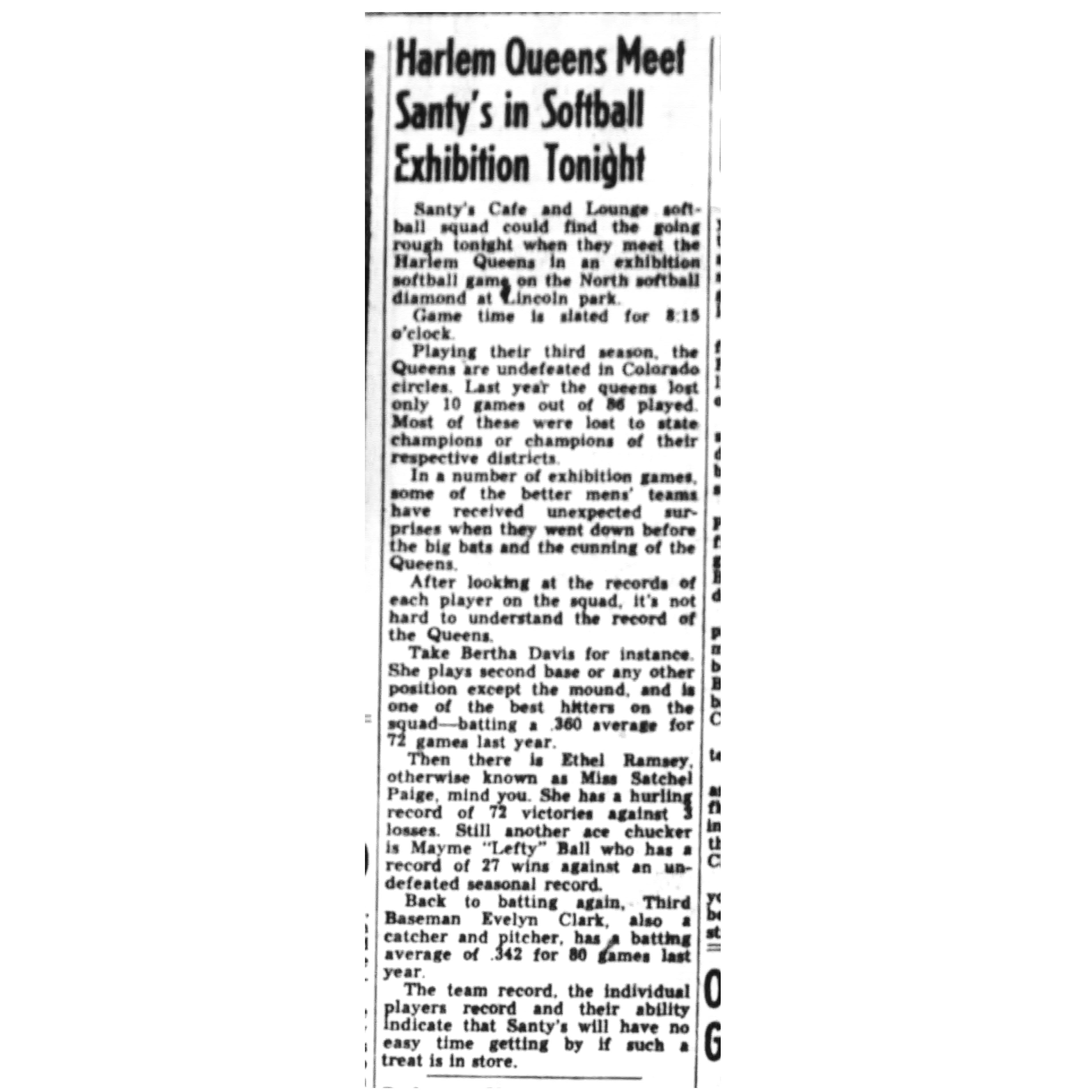
The Chicago Harlem Queens were one of the premier all-Black women’s softball teams of the late 1940s and early 1950s. Based in Chicago, they barnstormed extensively and were widely covered in the press. The Queens competed at a high level and produced standout players whose reputations extended beyond local circuits.
In the June 28, 1952 edition of the Cleveland, Ohio Call and Post, a photograph and caption identify “Evelyn Clarke” as a former third baseman for the local Perkins Stars and the 1950 Chicago Harlem Queens. The caption states that she “has been signed to a contract by the South Bend Indiana girls major league hardball team.” It further notes that she was “the only Negro girl on the team” and was in Cincinnati recovering from a torn shoulder ligament, with the expectation that she would return to the team the following week.
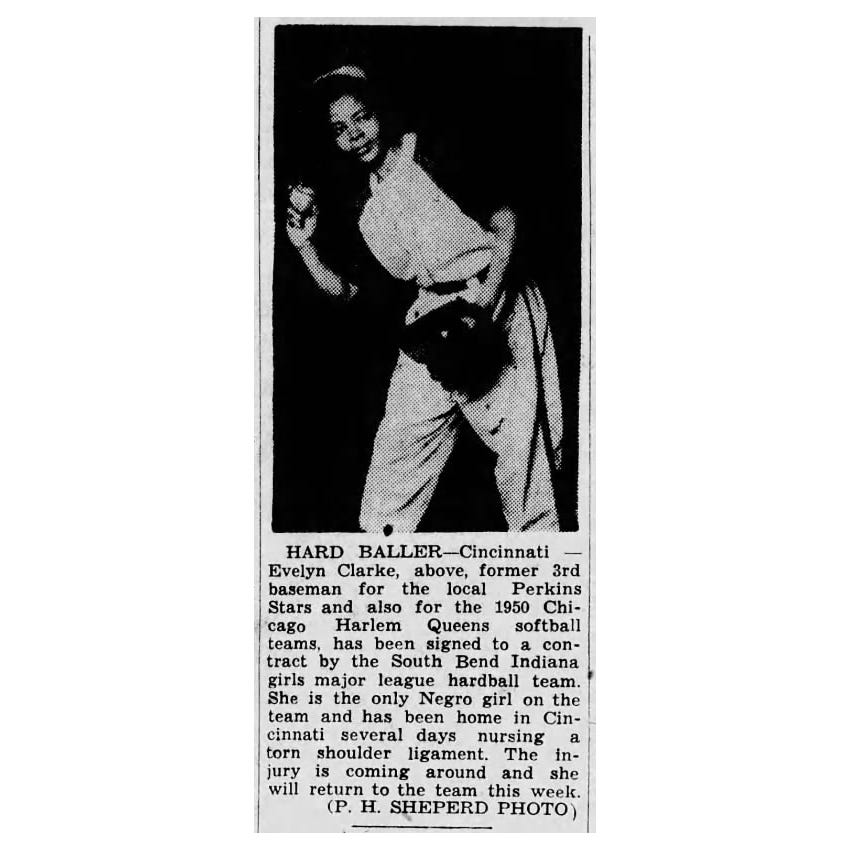
At the time, South Bend’s AAGPBL franchise was the Blue Sox, and the phrase “girls major league hardball team” was commonly used in contemporary reporting to describe league clubs. The Call and Post was a prominent Black newspaper with a strong record of covering African American athletic achievement. The specificity of the caption, including prior teams, injury details, and contractual language, suggests that the report was based on direct information rather than rumor.
However, Clarke’s (in past news clippings about the Harlem Queens, she was referred to as ‘Clark’) name does not appear on surviving 1952 South Bend Blue Sox rosters, nor does she appear in available team photographs from that season. This absence indicates that, if she did sign a contract, she likely never appeared in a regular-season game. Her reported shoulder injury may have prevented her from joining or remaining with the club.
Scholars of the AAGPBL have consistently documented the league’s racial exclusion. Historians have noted instances in which qualified Black women were denied meaningful opportunities, reinforcing the prevailing conclusion that no Black players were ever signed to official league contracts. If the Call and Post report accurately reflects a contractual agreement, Clarke’s case would not necessarily overturn that broader interpretation, but it would complicate it. It would suggest that at least one club may have been willing to test the league’s racial boundaries, even if circumstances ultimately prevented that effort from reaching the field.
Taken together, the June 28, 1952 clipping does not yet prove that Evelyn Clarke played in an official AAGPBL game. What it does provide is credible evidence that a Black woman from a prominent all-Black softball team was reportedly signed by a league club. Even if her injury prevented her from taking the field, this episode may represent a previously overlooked moment in which the rigid color line in the AAGPBL was challenged, if only briefly and incompletely.