

In 1951, Girls Baseball became the first nationally televised prime-time network series devoted to baseball in American television history. The ABC program followed the Tony Piet Queens of Chicago’s National Girls Baseball League, bringing their contests to a nationwide audience for nine Saturday nights from May through July.
The program was scheduled to premiere on Saturday, May 26, 1951, with the Queens facing the Chicago Bluebirds at Shewbridge Field. Rain postponed that opening contest, so the first broadcast took place the following Saturday, June 2, when the Thillens Checashers lost 2–0 to the Queens at that same ballpark.
One of the NGBL’s powerhouse franchises, the Queens were regarded at the time as the best team in America. They entered the 1951 campaign as defending champions, won the league crown again that year, and went on to capture four titles during the NGBL’s 11 seasons of existence.
The roster featured some of the greatest players in the history of the game, including Freda Savona, widely considered the best player of her generation, and her sister Olympia, a very good ballplayer in her own right. Their pitching staff included softball legends Betty Evans Grayson, Virginia “Ginny” Busick, and Ann Kmezich, all members of various softball halls of fame. Alice Kolski, the 1944 NGSL MVP, and Pat Carson, the league’s top slugger before Savona arrived, were also among the standouts.
ABC promoted the circuit under the name National Women’s Professional Baseball League, and the Queens were billed as the Queens of America. The NGBL was already a familiar presence on Chicago television by then. League games had been televised locally since at least 1947, with broadcasts alternating between WBKB and WENR. Girls Baseball took that local exposure to a national audience with a nine-week Saturday night series replacing roller derby on the network’s schedule. The broadcasts were later distributed to the West Coast through kinescope recordings.
Featuring announcer Pat Flanagan, the program was a groundbreaking moment in sports television. It was the first prime-time network television series devoted to a diamond sport in the United States.
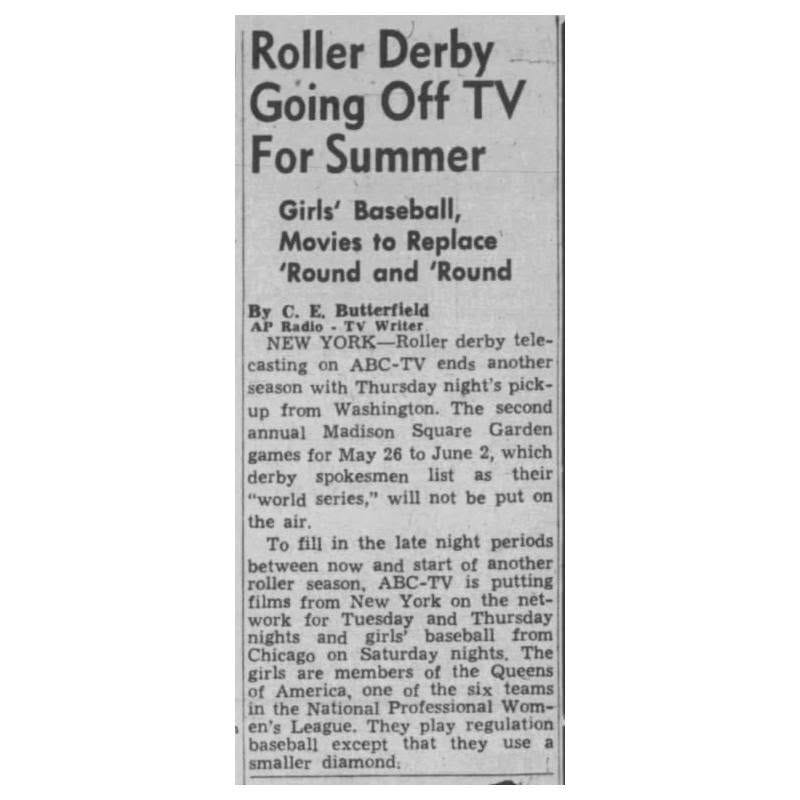
There was, however, a catch: the Queens weren’t a professional women’s baseball team. They were a professional women’s fastpitch softball club in the National Girls Baseball League, a Chicago-based organization that operated from 1944 through 1954. Originally known as the National Girls Softball League, the organization adopted the NGBL name in 1946.
Unfortunately, the schedule was created before African American star Betty Chapman signed with the NGBL’s Music Maids in July 1951, meaning viewers never got to see her compete on national television.
Here are the complete results of ABC’s Girls Baseball broadcasts featuring the Tony Piet Queens in 1951:
May 26: Queens vs. Bluebirds — Rainout
June 2: Queens 2, Checashers 0
June 9: Queens 16, Rockolas 0
June 16: Queens 16, Bluebirds 0 (Game 1 of a doubleheader was televised.)
June 23: Queens 2, Checashers 0
June 30: Queens 2, Rockolas 1 (Game 1 of a doubleheader was televised.)
July 7: Queens 6, Bluebirds 4
July 14: Checashers 2, Queens 1
July 21: Queens 7, Rockolas 6
The Queens finished the televised schedule with a 7–1 record, outscoring their opponents 52–15. Their only loss came on July 14, when the Checashers edged them 2–1.
All games were shot from Shewbridge Field.
ABC Brings Girls Baseball Back
The program was successful enough for ABC to bring it back the following summer. But when the network renewed the series for 1952, it made an important change: rather than continuing to follow the Queens, ABC shifted its coverage to an actual women’s baseball club.
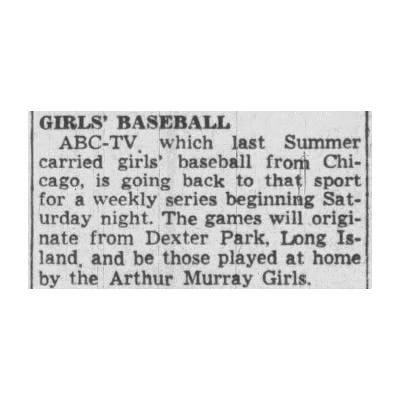
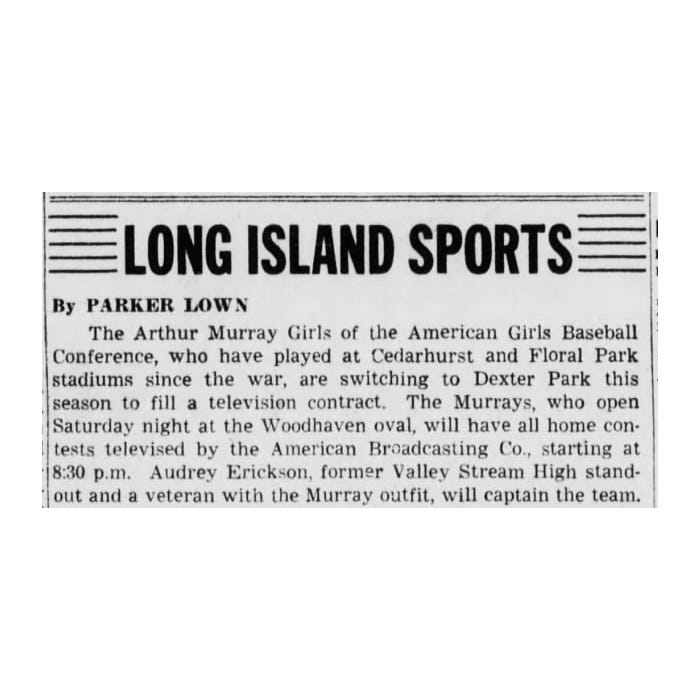
The team the network chose was the Arthur Murray Girls, based at Cedarhurst Stadium on Long Island and a member of the American Girls’ Baseball Conference (AGBC). The circuit had begun in 1945 as the American Girls’ Softball League (AGSL) before switching to a modified form of baseball in 1949 and adopting the AGBC name.
The Arthur Murray Girls had a long history of their own. The club began as the Yankee Girls and later played as the Colonial Girls before becoming the Greenwold–Long Island Jewels when the AGSL was founded in 1945. They landed on their most famous moniker in 1948, when the well-known Arthur Murray dance studio took over as sponsor. Newspaper writers soon started referring to the team simply as the “Dancers.”
The Murrays were no strangers to television. Their contests had been shown locally on New York station WPIX in the late 1940s, giving the players some experience performing before a TV audience. But the 1952 series would put the Dancers on a national network for the first time, with Don Dunphy and Bob Finnegan handling the announcing.
The league itself eventually became a mix of professional, semi-professional, and amateur clubs. From 1945 through 1947, the AGSL was affiliated with the Amateur Softball Association (ASA), which maintained strict rules regarding amateur status. Teams could even be suspended if there was any hint that compensation had changed hands. When the organization joined the National Softball Congress (NSC) in 1948, those restrictions no longer applied, allowing clubs to begin paying their players.
Some remained amateur, while others, like the Dancers, chose to pay.
When the circuit switched to baseball in 1949, it went independent and no longer had a governing body. Women’s baseball simply didn’t have an organization like the ASA or NSC to oversee it.
By the late 1940s and early 1950s, women’s pro baseball and softball had become big business, and the AGBC competed with the All-American Girls Professional Baseball League and the NGBL for players.
The Arthur Murray Girls were the cream of the crop. They won two championships during the four seasons of the AGSL and added two more after the league became the AGBC, taking the title in both 1951 and 1952.
For the ‘52 broadcasts, the club moved into Dexter Park in Woodhaven, Queens. The premiere on May 10 featured the Dancers against the Freeport Forest Jewels, which was significant for several reasons. Not only would it be the first nationally televised women’s baseball game, but it would also mark the debut of integrated women’s baseball on national television.
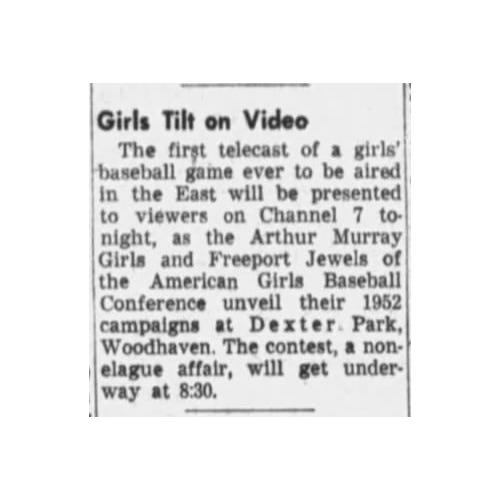
Freeport featured African American star Yvonne “Coky” Coker. One of the top players in the league, she debuted in August 1945 with the West New York (NJ) Traders and was the second Black woman to play in the circuit. The Arthur Murray Girls, then known as the Jewels, had previously featured Marie Roach, a phenom who played only one year with the club before leaving the sport after the 1945 season.
Coker did become the first Black woman to play in the American Girls’ Baseball Conference when the circuit made its transition to baseball in 1949.
The broadcasts continued for another seven weeks. A game on Tuesday, May 13, in which the Dancers faced the Bronx Alpines, was filmed for use in case of a rainout on any of the Saturday night telecasts. The next televised games are a little confusing because some TV listings said the Arthur Murray Girls faced the Bronx Alpines or Irvington (NJ) Amazons on May 17, and those same clubs are listed as well on the 24th, with the Queens Colleens also showing up in listings for that night.
Here is the complete schedule of each Saturday broadcast from May 10 to June 28. Unfortunately, I can’t find scores or results for all of the games:
May 10: Arthur Murray Girls defeat Freeport Forest Jewels — Preseason
May 17: Arthur Murray Girls defeat Bronx Alpines or Irvington Amazons — Preseason
May 24: Arthur Murray Girls defeat Bronx Alpines or Irvington Amazons or Queens Colleens — Preseason
May 31: Arthur Murray Girls vs Queens Colleens — Preseason (Rainout)
June 7: Arthur Murray Girls vs Queens Colleens — First Official Game of the Season Broadcast
June 14: Arthur Murray Girls vs Bronx Alpines
June 21: Arthur Murray Girls vs Huntington Manorettes — Rainout
June 28: Arthur Murray Girls vs Huntington Manorettes
The Huntington Manorettes also had a star of their own. Chinese-American ballplayer Sue Mae Lee was on the roster when the Manorettes faced the Dancers on June 21 and June 28. Lee was one of the most feared hitters in the league, giving viewers another glimpse of the remarkable talent that was taking the field in women’s baseball at the time.
One negative news report from later that year mentioned that the broadcast contract had been discontinued because the baseball wasn’t very good. Arthur Murray Girls star Audrey Erickson offered a similar assessment in her Nassau Daily Review-Star column, “On Distaff Side”, pointing to the loss of good ballplayers and the arrival of inexperienced teams as reasons for the declining quality of play.
But the Murrays played a good majority of their contract, with only July 5 and July 12 missing from the schedule. Some listings around the country still had Girls Baseball penciled into those Saturday slots.
The club returned to Cedarhurst Stadium on July 16 and would go on to win the league championship that season over the Bronx Alpines. Unfortunately, the team folded after 1952, along with a few other league mainstays. The circuit itself would also change, as the American Girls’ Baseball Conference name disappeared and the Eastern States Girls Baseball League (ESGBL) became the new moniker.
The ESGBL would carry on for two more seasons before folding in 1954. By then, the All-American Girls Professional Baseball League and National Girls Baseball League were also gone, bringing an end to a remarkable era when women’s baseball and softball had been played professionally across the country—and, for a brief moment, on national television.