

If you’ve read recent articles about the Women’s Pro Baseball League, you’ve probably seen references to the long history of professional women’s baseball in the United States. While it is encouraging to see renewed interest in that history, many accounts unintentionally blur the line between women’s baseball and women’s fastpitch softball.
Some of this confusion is also reinforced by secondary sources online. When writers rely on summaries without cross-checking contemporary newspapers and other primary documentation, inaccuracies can be repeated from one article to the next. The result is an increasingly obscured distinction between women’s fastpitch softball and women’s baseball, two closely related but distinct sports. Wikipedia is one example where this can occur, though it is far from the only source.
Because I value specificity and precision when discussing women’s sports history, I’d like to help untangle some of that confusion.
The central point is simple: during the 1940s and 1950s, you cannot determine what sport a women’s league played simply by reading its name.
A common description of the era reads something like this:
The problem is that this framing is not quite accurate. The National Girls Baseball League (NGBL) was not a professional baseball league. It was a women’s professional fastpitch softball league, and it remained this throughout its entire 11-season existence from 1944 through 1954.
At first glance, that may sound contradictory. After all, it carried the name “baseball.”
That’s precisely why this topic requires closer examination.
Baseball, softball, and why the line blurred
During the 1940s and 1950s, “baseball” and “softball” were often used interchangeably. But that interchangeability had deeper roots.
Softball itself originated in the late 19th century as an indoor adaptation of baseball, often described as “indoor baseball”. Early versions were designed simply to keep the game playable during winter months, and they closely mirrored baseball’s rules with only modest adjustments for space and equipment.
As the sport developed, organizations such as the Amateur Softball Association helped standardize rules, but those rules still remained structurally similar to baseball: bases, innings, batting order, fielding positions, and game flow all closely tracked the parent sport.
Even the terminology of early decades reflects that connection. Before the name “softball” became standard in the 1920s, the game was known by regional variations such as kitten ball, mush ball, and playground baseball. To many players and spectators, it was not viewed as a separate sport so much as a modified form of baseball itself.
That history helps explain why the terms continued to overlap in the 1940s.
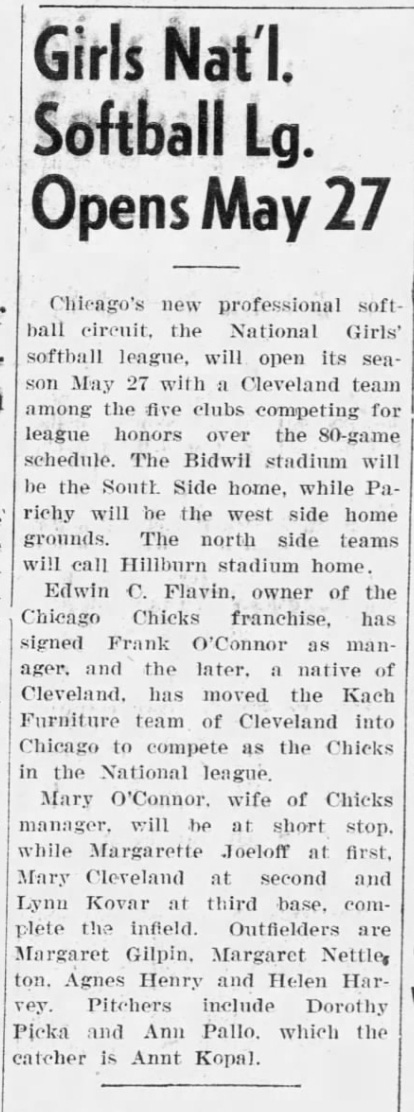
A clear example is Chicago’s National Girls Softball League, which rebranded in 1946 as the National Girls Baseball League. The name changed, but the game did not.
Despite the new name, the league continued to play women’s fastpitch softball for the remainder of its existence.
League officials believed their game more closely resembled baseball than the public image associated with the word “softball.” Fastpitch shared much of baseball’s structure and strategy, differing mainly in underhand pitching, a larger hard ball, shorter base paths, and related rule variations.
The term “softball” also carried limitations. Taken literally, it suggests a softer ball than baseball, even though fastpitch used a hard, tightly wound ball, simply larger in size.
In Chicago, the issue was even more pronounced. “Softball” was strongly associated with the city’s popular 16-inch game, played with an oversized ball and often without gloves. As slow-pitch formats gained popularity, the word increasingly evoked recreation rather than elite competition.
By adopting the name National Girls Baseball League, organizers could distinguish their product from other forms of softball while emphasizing its structural similarity to baseball.
In some ways, this distinction was similar to the situation in Iowa high school sports, where men played the standard five-player version of basketball while women competed under separate six-on-six rules. Although both were considered basketball, differences in rules and style led many people to view them as distinct versions of the game.
Women’s baseball and women’s fastpitch softball occupied a similar space during the 1940s and 1950s. They shared common roots and many of the same strategies, players, and promoters, yet they remained separate sports with their own rules and identities.
For fans watching the era unfold, however, the distinction was not always obvious.
Wartime sports blurred the boundaries further
That said, confusion was not limited to league branding. It was reinforced by the broader sporting environment of the era.
During World War II and the immediate postwar years, exhibition baseball and softball games were extremely common. The wartime baseball landscape included military service teams, semiprofessional clubs, amateur men’s leagues, professional barnstorming teams, and men’s fastpitch softball teams. Women’s teams regularly competed against many of them, often under modified rules designed to balance competition.
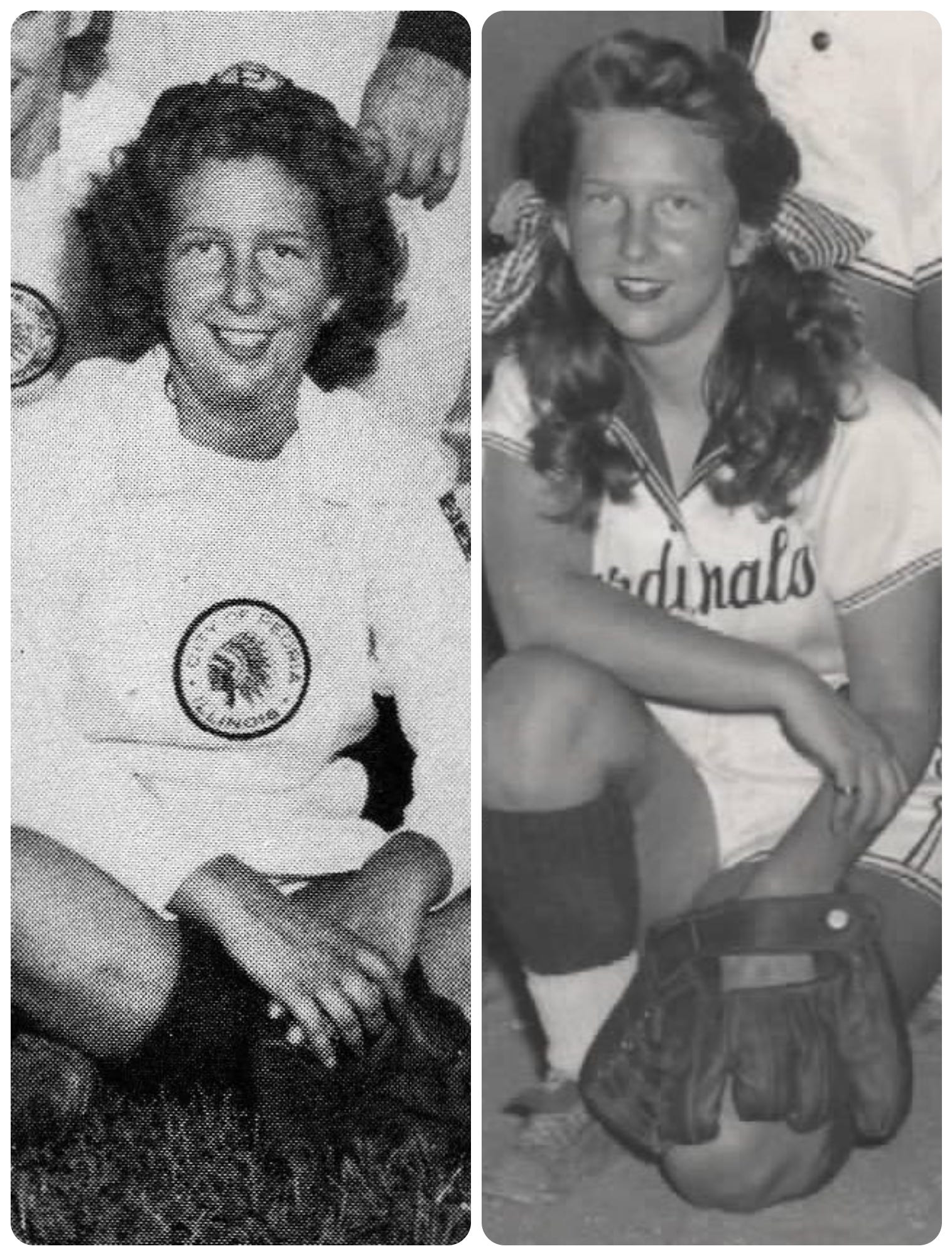
Former All-American Girls Professional Baseball League and National Girls Baseball League player Maybelle Blair once recalled that while playing for the Jax Maids in Bakersfield, California, her team faced a men’s fastpitch softball club. To even the contest, the women pitched from a shorter distance than the men. Games like these demonstrate how flexible the rules could be when different versions of bat-and-ball sports met on the same field.
Player movement also contributed to the confusion. Athletes frequently moved between fastpitch softball and women’s baseball leagues depending on opportunity, geography, and pay. A fan might see the same player compete in one format one season and another the next. Without a clear understanding of the rule differences, it would have been easy to assume the sports were identical.
In many ways, that assumption was understandable. The games shared players, promoters, and audiences, and they often shared venues as well.
Why modern histories get this wrong
This evolving environment also shaped how leagues presented themselves. The “baseball” label became a way to emphasize competitiveness and distance from recreational softball, even when the underlying game remained fastpitch.
The confusion carries into modern writing in part because wartime and postwar sports culture already treated the two games as variations of the same tradition. With overlapping rules, shared players, and interchangeable terminology, “baseball” and “softball” often functioned less as precise categories and more as contextual descriptions.
This distinction is also one reason the National Baseball Hall of Fame and Museum recognizes the All-American Girls Professional Baseball League, but not the National Girls Baseball League as a professional women’s baseball league. The two organizations were contemporaries, but they played different sports.
The All-American League example
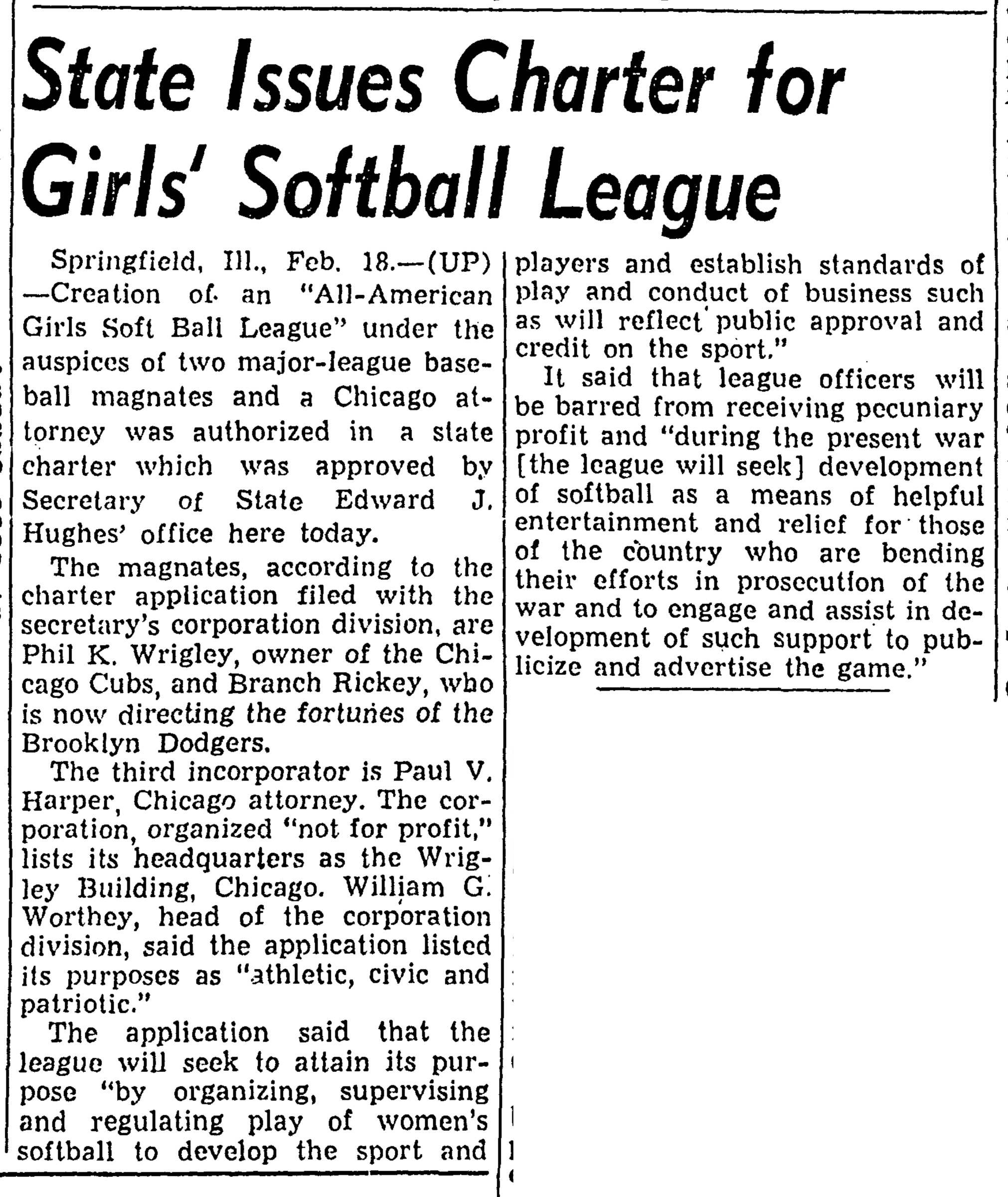
A useful comparison is the All-American League itself. It did not begin as a baseball organization. In its earliest form, it operated as the All-American Girls Soft Ball League, playing fastpitch softball under evolving rules and expectations. In the following year, the league transitioned toward baseball and adopted baseball terminology in its identity, ultimately becoming the All-American Girls Professional Baseball League.
This shift reflected both a change in branding and a broader attempt to align the league with traditional baseball in the public imagination.
The same sport—often the same athletes, but a changing name to reflect changing goals.
Other parallel leagues
The same applies to the International Girls Baseball League (IGBL).
Founded by NGBL team owner Frank Darling in 1952, the IGBL also played women’s professional fastpitch softball. It used underhand pitching and an 11-inch softball, and many of its teams carried over familiar NGBL names. Several AAGPBL players participated, but that did not change the sport being played.
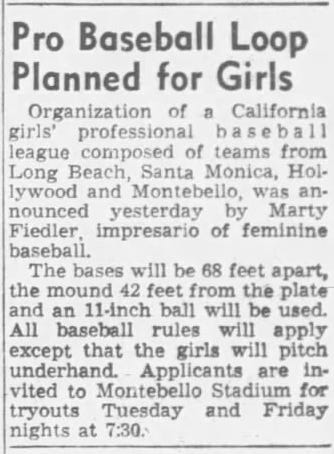
Another professional league followed a similar pattern. Like the NGBL, it used “baseball” in its name while playing women’s fastpitch softball with an 11-inch ball. This was the California Girls Professional Baseball League (CGPBL), which operated for a single season in 1946.
The New York metropolitan-based American Girls Softball League (later known as the American Girls Baseball Conference and the Eastern States Girls Baseball League) was another such league that began in 1945. It featured a mix of professional, semi-professional, and amateur clubs and stands alongside the AAGPBL for its longevity, high level of competition, and successful transition from fastpitch softball to baseball in 1949, all while remaining integrated throughout its existence.
Making sense of the landscape
Once we recognize that league names did not always reflect the sport being played, the landscape of women’s athletics in the 1940s and 1950s becomes clearer.
Some leagues used “baseball” while playing fastpitch softball. Others began as softball before transitioning to baseball. Still others were established as baseball leagues from the outset. Even within the same regional ecosystems, clubs often moved between formats over time.
Among them were:
● All-American Girls Soft Ball League / All-American Girls Baseball League / All-American Girls Professional Baseball League (Midwest, 1943–1954) — Began as fastpitch softball before transitioning to baseball.
● National Girls Softball League / National Girls Baseball League (Chicago metropolitan area, 1944–1954) — Professional women’s fastpitch softball throughout its existence despite the 1946 name change.
● American Girls Softball League / American Girls Baseball Conference / Eastern States Girls Baseball League (New York metropolitan area, 1945–1954) — Began as fastpitch softball before transitioning to baseball in 1949.
● California Girls Professional Baseball League (Los Angeles metropolitan area, 1946) — Professional women’s fastpitch softball.
● Central Indiana Girls’ Baseball League (Indiana, 1948–1949) — Regional developmental league affiliated with the AAGPBL that included clubs which had previously competed in fastpitch softball before converting to baseball after formation.
● Chicago Girls Baseball League (Chicago metropolitan area, 1948–1950) — Regional women’s baseball league that served as the AAGPBL’s official developmental (”minor”) league.
● Eastern Girls’ Baseball League (Pennsylvania, 1950) — Regional developmental league affiliated with the AAGPBL that included clubs which had previously played fastpitch softball before adopting baseball after formation.
● Japan Women’s Baseball Federation (Japan, 1950–1959) — Professional for its first two seasons before becoming amateur in 1952.
● International Girls Baseball League (Miami metropolitan area, 1952–1953) — Professional women’s fastpitch softball.
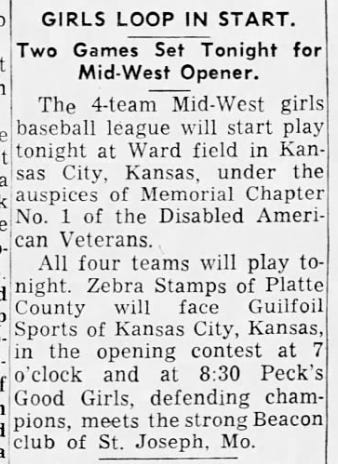
● Mid-West Girls Baseball League (Kansas City metropolitan area, 1959) — Four-team regional women’s baseball league.
So what’s in a name?
During the 1940s and 1950s—often less than we assume.
League names reflected marketing, regional tradition, and public perception just as much as the rules played on the field. To understand this era accurately, we have to look beyond what leagues called themselves and focus on how the game was actually played. Only then can we fully appreciate these organizations for what they truly were—not simply what they were named.